Cloud Migration to OCI: A Practical Framework for Enterprise Workloads
Migration

Cloud Migration to OCI: A Practical Framework for Enterprise Workloads

Bharath L

Bharath L

Oracle Cloud Specialist

March 8, 202415 min read

Migrating enterprise workloads to Oracle Cloud requires careful planning across assessment, design, migration, and optimization phases. This framework covers the 6 Rs of migration, tooling options, and common pitfalls to avoid.

Migrating to Oracle Cloud Infrastructure is a strategic initiative that requires a structured approach. The most successful migrations follow a phased methodology that balances speed with risk management.

The 6 Rs of Cloud Migration

The migration strategy for each workload should be determined during the assessment phase:

Rehost (Lift and Shift) moves workloads to OCI with minimal changes, using tools like OCI Database Migration Service or third-party solutions. This is the fastest approach but may not fully leverage cloud-native capabilities.

Replatform makes targeted optimizations during migration — for example, moving from self-managed Oracle Database to Autonomous Database, or from on-premises Kubernetes to OKE.

Refactor involves re-architecting applications to be cloud-native, adopting microservices, serverless functions, and managed services. This provides the greatest long-term benefits but requires the most effort.

Assessment and Discovery

The OCI Migration Advisor and third-party tools like Movere and CloudScape help inventory your existing environment, map dependencies, and estimate OCI costs. This phase typically takes 2–6 weeks for enterprise environments.

Migration Tooling

OCI provides native tools for common migration scenarios. Database Migration Service handles Oracle Database migrations with minimal downtime using GoldenGate replication. OCI Compute Migration (via Rackware or Zerto) handles server migrations with automated conversion and testing.

Post-Migration Optimization

After migration, focus on right-sizing instances, implementing autoscaling, enabling Reserved Instances for predictable workloads, and adopting OCI-native services to reduce operational overhead and cost.

Cloud Migration to OCI: A Practical Framework for Enterprise Workloads

Tags

MigrationStrategyEnterpriseCloud Adoption
Bharath L

About the Author

Bharath L

Oracle Cloud Specialist

Oracle Cloud Specialist providing end-to-end solutions for Oracle Fusion, OIC, VBCS, and ATP. Expertise in Oracle Applications (Fusion & EBS) for SCM, HCM, Finance, and BI/OTBI reporting with complex system integrations. Passionate about sharing real-world experience and learning together.
More in Migration

Why Choose OCI and OIC for Fusion Cloud Applications: Key Takeaways !!!
Oracle Integration Cloud

Why Choose OCI and OIC for Fusion Cloud Applications: Key Takeaways !!!

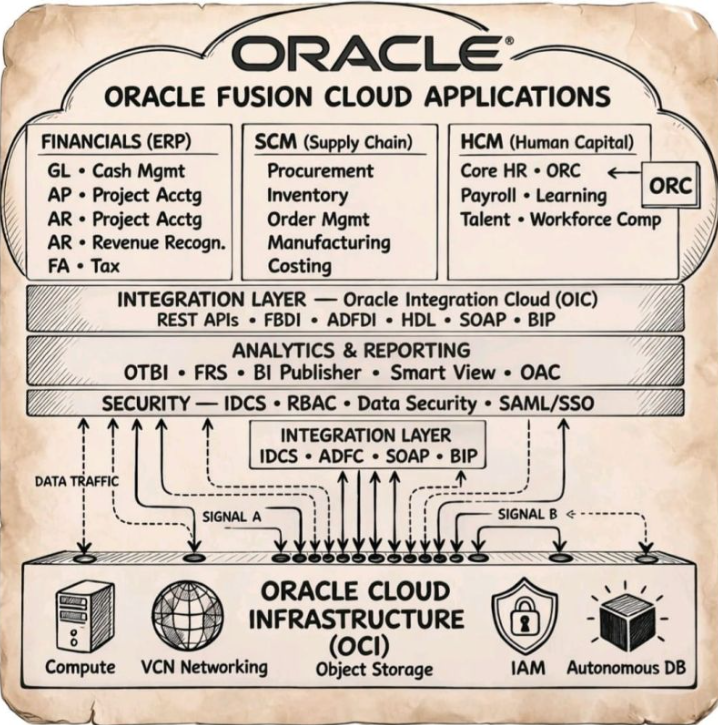
This image shows the end-to-end architecture of Oracle Fusion Cloud Applications, explaining how business applications, integrations, analytics, and infrastructure are connected. 1. Core Application Modules (Top Layer) These are the main business applications (ERP systems): Financials (ERP) - Handles finance operations: General Ledger (GL), Accounts Payable (AP), Accounts Receivable (AR), Fixed Assets (FA), Tax & Revenue Recognition. Focus: Accounting & financial reporting SCM (Supply Chain Management) - Handles operations & logistics: Procurement, Inventory, Order Management, Manufacturing, Costing. Focus: End-to-end supply chain operations HCM (Human Capital Management) - Handles HR processes: Core HR, Payroll, Talent Management, Learning, Workforce Compensation, ORC (Oracle Recruiting Cloud). Focus: Employee lifecycle management 2. Integration Layer (How Systems Connect) This layer enables communication between systems using REST APIs, SOAP, FBDI / ADFDI (data upload tools), HDL (HCM Data Loader), BIP (BI Publisher). Powered by: Oracle Integration Cloud (OIC). Purpose: Connect ERP with external systems and enable automation & data exchange 3. Analytics & Reporting Tools for reporting and insights: OTBI (Oracle Transactional BI), FRS (Financial Reporting Studio), BI Publisher, Smart View (Excel integration), OAC (Oracle Analytics Cloud). Purpose: Turn data into business insights 4. Security Layer Ensures system access and data protection: IDCS (Identity Cloud Service), RBAC (Role-Based Access Control), Data Security, SAML / SSO (Single Sign-On). Purpose: Control who can access what 5. Oracle Cloud Infrastructure (OCI) – Foundation Layer All applications run on Oracle Cloud Infrastructure (OCI) with key components: Compute (servers), VCN Networking (network connectivity), Object Storage (data storage), IAM (identity & access management), Autonomous Database (self-managing database). This is the technical backbone of the entire system. 6. Data Flow (Signals & Traffic) The arrows show continuous data exchange between applications and infrastructure, integration between internal modules and external systems, and real-time or batch data movement. Key Takeaway: Oracle Fusion Cloud is a fully integrated ecosystem where applications, data, security, and infrastructure work together seamlessly.

Bharath L

Bharath L

August 25, 202516 min
Comprehensive Guide: Creating and Using AI Agents in Oracle Integration Cloud (OIC)
Oracle Integration Cloud

Comprehensive Guide: Creating and Using AI Agents in Oracle Integration Cloud (OIC)

Learn how to create, configure, and deploy autonomous AI agents in Oracle Integration Cloud. This comprehensive guide covers understanding agentic AI, prerequisites, step-by-step creation process, thinking patterns, tool registration, and practical examples for enterprise automation.

Bharath L

Bharath L

April 9, 202622 min