Oracle Integration CloudWhy Choose OCI and OIC for Fusion Cloud Applications: Key Takeaways !!!
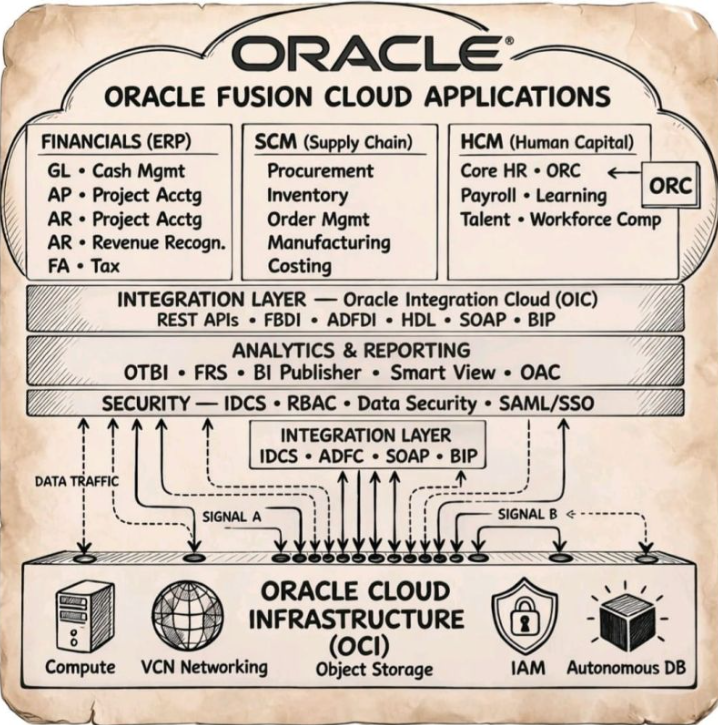
This image shows the end-to-end architecture of Oracle Fusion Cloud Applications, explaining how business applications, integrations, analytics, and infrastructure are connected.
1. Core Application Modules (Top Layer)
These are the main business applications (ERP systems):
Financials (ERP) - Handles finance operations: General Ledger (GL), Accounts Payable (AP), Accounts Receivable (AR), Fixed Assets (FA), Tax & Revenue Recognition. Focus: Accounting & financial reporting
SCM (Supply Chain Management) - Handles operations & logistics: Procurement, Inventory, Order Management, Manufacturing, Costing. Focus: End-to-end supply chain operations
HCM (Human Capital Management) - Handles HR processes: Core HR, Payroll, Talent Management, Learning, Workforce Compensation, ORC (Oracle Recruiting Cloud). Focus: Employee lifecycle management
2. Integration Layer (How Systems Connect)
This layer enables communication between systems using REST APIs, SOAP, FBDI / ADFDI (data upload tools), HDL (HCM Data Loader), BIP (BI Publisher). Powered by: Oracle Integration Cloud (OIC). Purpose: Connect ERP with external systems and enable automation & data exchange
3. Analytics & Reporting
Tools for reporting and insights: OTBI (Oracle Transactional BI), FRS (Financial Reporting Studio), BI Publisher, Smart View (Excel integration), OAC (Oracle Analytics Cloud). Purpose: Turn data into business insights
4. Security Layer
Ensures system access and data protection: IDCS (Identity Cloud Service), RBAC (Role-Based Access Control), Data Security, SAML / SSO (Single Sign-On). Purpose: Control who can access what
5. Oracle Cloud Infrastructure (OCI) – Foundation Layer
All applications run on Oracle Cloud Infrastructure (OCI) with key components: Compute (servers), VCN Networking (network connectivity), Object Storage (data storage), IAM (identity & access management), Autonomous Database (self-managing database). This is the technical backbone of the entire system.
6. Data Flow (Signals & Traffic)
The arrows show continuous data exchange between applications and infrastructure, integration between internal modules and external systems, and real-time or batch data movement.
Key Takeaway: Oracle Fusion Cloud is a fully integrated ecosystem where applications, data, security, and infrastructure work together seamlessly.