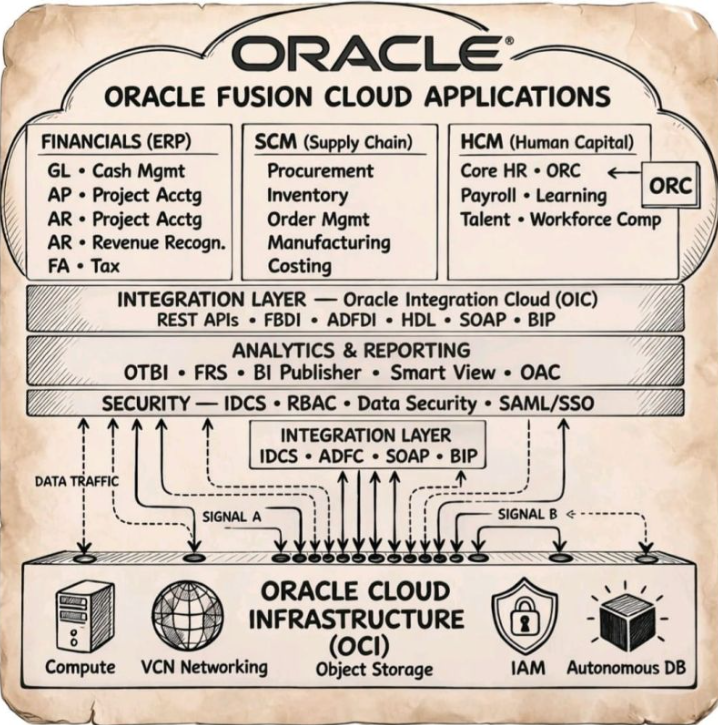
Oracle Integration Cloud Best Practices
Master OIC integration design patterns, performance optimization, error handling, security governance, and development lifecycle best practices for enterprise-grade integrations.
Oracle Integration Cloud (OIC) is a powerful platform for connecting enterprise applications and services. Following best practices ensures your integrations are scalable, maintainable, and resilient.
1. Integration Design & Patterns
Asynchronous for Long-Running Tasks: Design any integration expected to take more than two minutes as an asynchronous flow to prevent client and server-side timeouts.
Modularize Complex Logic: Break down large, complex workflows into smaller, reusable child integrations. This improves readability and allows you to call common logic from multiple parent integrations.
Avoid Chatty Synchronous Calls: Instead of making multiple small requests, use coarse-grained APIs or batching to reduce network overhead.
2. Performance & Data Handling
Batch Processing for Bulk Data: Use the Read File with Segments option to process large files in parallel. Chunk records into smaller batches rather than pushing massive loads all at once.
Implement Throttling: Use rate-limiting and throttling mechanisms when connecting to external systems to avoid overwhelming target endpoints.
3. Error Handling & Monitoring
Proactive Fault Handling: Implement Global Fault Handlers to standardize error logic across your project.
Business Identifiers: Always define business identifiers (tracking fields) to make it easier to search for specific instances in the monitoring dashboard.
4. Security & Governance
Standard Naming Conventions: Establish and strictly follow a naming convention for integrations, connections, and lookups to ensure environment consistency.
Secure Authentication: Prefer OAuth over basic authentication to improve security and avoid rate-limiting issues from identity services.
5. Development Lifecycle
Automate CI/CD: Use the OIC REST APIs to automate the promotion of integrations between development, staging, and production environments.
Versioning Strategy: Adopt a standard versioning format and document change details in the integration's description field.

Tags

About the Author
Bharath L
Oracle Cloud Specialist
Oracle Cloud Specialist providing end-to-end solutions for Oracle Fusion, OIC, VBCS, and ATP. Expertise in Oracle Applications (Fusion & EBS) for SCM, HCM, Finance, and BI/OTBI reporting with complex system integrations. Passionate about sharing real-world experience and learning together.