Why Choose OCI and OIC for Fusion Cloud Applications: Key Takeaways !!!
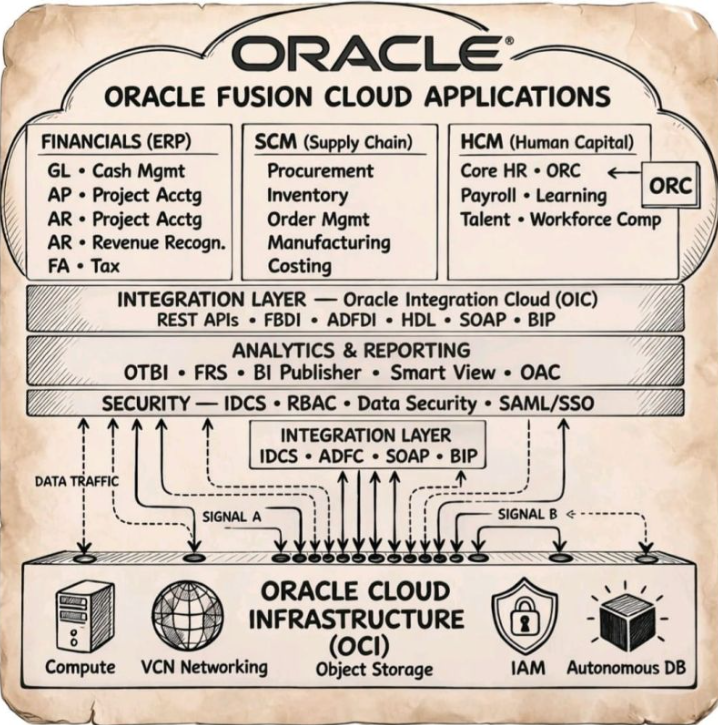
This image shows the end-to-end architecture of Oracle Fusion Cloud Applications, explaining how business applications, integrations, analytics, and infrastructure are connected. 1. Core Application Modules (Top Layer) These are the main business applications (ERP systems): Financials (ERP) - Handles finance operations: General Ledger (GL), Accounts Payable (AP), Accounts Receivable (AR), Fixed Assets (FA), Tax & Revenue Recognition. Focus: Accounting & financial reporting SCM (Supply Chain Management) - Handles operations & logistics: Procurement, Inventory, Order Management, Manufacturing, Costing. Focus: End-to-end supply chain operations HCM (Human Capital Management) - Handles HR processes: Core HR, Payroll, Talent Management, Learning, Workforce Compensation, ORC (Oracle Recruiting Cloud). Focus: Employee lifecycle management 2. Integration Layer (How Systems Connect) This layer enables communication between systems using REST APIs, SOAP, FBDI / ADFDI (data upload tools), HDL (HCM Data Loader), BIP (BI Publisher). Powered by: Oracle Integration Cloud (OIC). Purpose: Connect ERP with external systems and enable automation & data exchange 3. Analytics & Reporting Tools for reporting and insights: OTBI (Oracle Transactional BI), FRS (Financial Reporting Studio), BI Publisher, Smart View (Excel integration), OAC (Oracle Analytics Cloud). Purpose: Turn data into business insights 4. Security Layer Ensures system access and data protection: IDCS (Identity Cloud Service), RBAC (Role-Based Access Control), Data Security, SAML / SSO (Single Sign-On). Purpose: Control who can access what 5. Oracle Cloud Infrastructure (OCI) – Foundation Layer All applications run on Oracle Cloud Infrastructure (OCI) with key components: Compute (servers), VCN Networking (network connectivity), Object Storage (data storage), IAM (identity & access management), Autonomous Database (self-managing database). This is the technical backbone of the entire system. 6. Data Flow (Signals & Traffic) The arrows show continuous data exchange between applications and infrastructure, integration between internal modules and external systems, and real-time or batch data movement. Key Takeaway: Oracle Fusion Cloud is a fully integrated ecosystem where applications, data, security, and infrastructure work together seamlessly.
Oracle Fusion Cloud Applications represent a modern, cloud-native approach to enterprise resource planning, supply chain management, human capital management, and financial operations. However, Fusion doesn't exist in isolation—it must integrate with legacy systems, third-party applications, and external partners. This is where Oracle Integration Cloud (OIC) becomes indispensable.
In this article, we explore why OIC is the optimal integration platform for Fusion Cloud Applications and provide key takeaways for organizations planning their cloud transformation.
The Integration Challenge
Organizations adopting Fusion Cloud face a critical decision: how to integrate Fusion with existing systems while maintaining data consistency, security, and performance. The challenge is multifaceted:
- Legacy System Connectivity — Connecting Fusion to on-premise ERP, databases, and custom applications
- Third-Party Integrations — Integrating with SaaS applications (Salesforce, Workday, Concur, etc.)
- Partner Ecosystem — Enabling supplier portals, customer self-service, and B2B integrations
- Real-Time Data Sync — Maintaining data consistency across systems in near-real-time
- Compliance & Security — Ensuring data protection, audit trails, and regulatory compliance
While point-to-point integrations might seem simpler, they quickly become unmaintainable as the number of systems grows. OIC provides a centralized, enterprise-grade integration platform designed specifically for cloud-native architectures.
Why OIC is the Strategic Choice for Fusion
### 1. Native Fusion Connector
OIC includes a pre-built, fully-supported connector for Oracle Fusion Cloud Applications. This connector:
- Exposes Fusion APIs directly — Access over 500 Fusion REST APIs without custom development
- Handles authentication seamlessly — OAuth integration with Fusion identity services
- Supports real-time events — Subscribe to Fusion business events (PO created, invoice submitted, etc.)
- Includes error handling — Built-in retry logic and fault handling for reliability
Key Takeaway: Using the native Fusion connector eliminates the need for custom API integration code, reducing development time by 60-70% and improving maintainability.
### 2. Pre-Built Adapters for Common Systems
OIC includes 150+ pre-built adapters for enterprise applications:
- ERP Systems — SAP, NetSuite, Infor, Dynamics 365
- CRM Systems — Salesforce, Microsoft Dynamics, HubSpot
- HCM Systems — Workday, SuccessFactors, BambooHR
- Finance Systems — Concur, Coupa, Bill.com
- Database Connectors — Oracle, SQL Server, PostgreSQL, MySQL
- Messaging & File Transfer — EDI, SFTP, REST, SOAP, JMS
Each adapter includes pre-configured mappings, error handling, and best practices. This means you don't need to build custom connectors—just configure and deploy.
Key Takeaway: Pre-built adapters reduce integration development time by 50-70% and ensure best-practice implementations from day one.
### 3. Cloud-Native Architecture
OIC is built on Oracle Cloud Infrastructure (OCI) and designed for cloud-native workloads:
- Auto-Scaling — Automatically scales to handle peak loads without manual intervention
- High Availability — Multi-region deployment with automatic failover
- 99.95% SLA — Enterprise-grade uptime guarantees
- Pay-As-You-Go Pricing — No upfront licensing costs; pay only for what you use
Unlike on-premise integration platforms, OIC eliminates infrastructure management overhead. Your team focuses on integration logic, not server maintenance.
Key Takeaway: Cloud-native architecture means zero infrastructure management, automatic scaling, and predictable costs—ideal for organizations modernizing to the cloud.
### 4. Unified Integration Platform
OIC consolidates multiple integration patterns into a single platform:
- Synchronous Integrations — Real-time request-response patterns
- Asynchronous Integrations — Event-driven, message-based patterns
- Batch Processing — Scheduled jobs for bulk data transfers
- File Transfer — SFTP, FTP, and cloud storage integrations
- EDI & B2B — Trading partner management and EDI translation
- API Management — Expose internal systems as managed APIs
Instead of juggling multiple tools (ESB, API gateway, batch scheduler), OIC handles all integration patterns in one platform.
Key Takeaway: A unified platform reduces tool sprawl, simplifies operations, and improves integration consistency across your organization.
### 5. Security & Compliance Built-In
OIC provides enterprise-grade security features:
- Encryption in Transit & at Rest — TLS 1.2+ and AES-256 encryption
- OAuth & SAML Support — Secure authentication with identity providers
- Role-Based Access Control (RBAC) — Fine-grained permissions for team members
- Audit Logging — Complete audit trail of all integration activities
- Compliance Certifications — SOC 2, ISO 27001, FedRAMP, HIPAA, PCI-DSS
- Data Masking — Automatically mask sensitive data in logs
Fusion stores sensitive business data (payroll, financial records, supplier information). OIC ensures this data is protected throughout the integration lifecycle.
Key Takeaway: Built-in security and compliance features eliminate the need for custom security implementations and reduce audit risk.
### 6. Monitoring & Observability
OIC provides comprehensive monitoring and troubleshooting capabilities:
- Real-Time Dashboards — Monitor integration health, throughput, and error rates
- Detailed Logs — Track every message through the integration flow
- Business Identifiers — Search for specific business transactions (PO #, Invoice #, etc.)
- Alerting — Proactive notifications for integration failures
- Performance Analytics — Identify bottlenecks and optimize slow integrations
When integration issues occur, OIC provides the visibility needed to diagnose and resolve them quickly.
Key Takeaway: Comprehensive monitoring reduces mean-time-to-resolution (MTTR) from hours to minutes, improving operational efficiency.
OIC vs. Alternative Approaches
### OIC vs. Point-to-Point Integrations
| Aspect | Point-to-Point | OIC |
|--------|---|---|
| Development Time | High (custom code for each integration) | Low (pre-built adapters) |
| Maintenance | High (each integration is independent) | Low (centralized platform) |
| Scalability | Limited (hard to add new systems) | High (easy to add new integrations) |
| Security | Varies (depends on developer skill) | Enterprise-grade (built-in) |
| Cost | Low initially, high long-term | Predictable, scales with usage |
Verdict: Point-to-point works for 1-2 integrations but becomes unmaintainable at scale. OIC is the better choice for organizations with 5+ integrations.
### OIC vs. Custom ESB Solutions
| Aspect | Custom ESB | OIC |
|--------|---|---|
| Setup Time | Months (infrastructure + configuration) | Days (cloud-hosted, pre-configured) |
| Infrastructure | On-premise servers (high capex) | Cloud-hosted (low opex) |
| Pre-Built Connectors | Limited (custom development) | 150+ adapters (ready-to-use) |
| Scalability | Manual (add servers) | Automatic (cloud-native) |
| Support | Internal team only | Oracle support + community |
Verdict: Custom ESB solutions require significant infrastructure investment and maintenance. OIC provides faster time-to-value with lower operational overhead.
### OIC vs. Other iPaaS Platforms
| Aspect | MuleSoft | Boomi | Zapier | OIC |
|--------|---|---|---|---|
| Fusion Native Connector | No (custom) | No (custom) | No | Yes ✓ |
| Enterprise Security | Yes | Yes | Limited | Yes ✓ |
| Pricing Model | License-based | Subscription | Freemium | Pay-as-you-go |
| On-Premise Support | Yes | Yes | No | Yes ✓ |
| Oracle Ecosystem | Limited | Limited | No | Optimized ✓ |
Verdict: While other iPaaS platforms are capable, OIC is purpose-built for Oracle applications and offers the best Fusion integration experience.
Key Takeaways
### 1. Native Integration Advantage
OIC's native Fusion connector provides the fastest, most reliable path to integrating Fusion with other systems. Use it as your primary integration approach.
### 2. Accelerate Time-to-Value
Pre-built adapters and connectors reduce integration development time by 50-70%. Your team can focus on business logic, not infrastructure.
### 3. Reduce Operational Complexity
A unified integration platform eliminates tool sprawl and simplifies operations. Fewer tools = fewer things to manage and monitor.
### 4. Enterprise Security & Compliance
OIC provides built-in security, encryption, audit logging, and compliance certifications. No need to build custom security solutions.
### 5. Scalability & Performance
Cloud-native architecture automatically scales to handle peak loads. Pay only for what you use—no overprovisioning.
### 6. Faster Troubleshooting
Comprehensive monitoring and logging reduce mean-time-to-resolution from hours to minutes. Operational efficiency improves significantly.
### 7. Future-Proof Your Integration Strategy
OIC is continuously updated with new adapters, features, and improvements. Your integration platform evolves with your business needs.
Recommendations for Fusion Implementations
For organizations adopting Fusion Cloud:
1. Evaluate OIC early — During the Fusion selection process, assess OIC as your integration platform. It's the strategic choice.
2. Design for OIC — Architect your Fusion implementation with OIC in mind. Use Fusion APIs that OIC supports natively.
3. Prioritize high-value integrations — Start with integrations that deliver immediate business value (supplier data sync, invoice matching, etc.).
4. Invest in OIC expertise — Train your team on OIC best practices. A skilled OIC team is a competitive advantage.
5. Plan for scale — Design your integration architecture to accommodate future systems. OIC scales with your organization.
Conclusion
Oracle Integration Cloud is not just another integration tool—it's the strategic platform for organizations adopting Oracle Fusion Cloud Applications. With native Fusion connectors, 150+ pre-built adapters, cloud-native architecture, and enterprise-grade security, OIC accelerates time-to-value while reducing operational complexity.
For organizations serious about cloud transformation, OIC is the logical choice. It's built for Fusion, optimized for the cloud, and designed for enterprise scale.
The question isn't whether to use OIC for Fusion integrations—it's how quickly you can get started.
Tags

About the Author
Bharath L
Oracle Cloud Specialist
Oracle Cloud Specialist providing end-to-end solutions for Oracle Fusion, OIC, VBCS, and ATP. Expertise in Oracle Applications (Fusion & EBS) for SCM, HCM, Finance, and BI/OTBI reporting with complex system integrations. Passionate about sharing real-world experience and learning together.