Real-World Fusion SCM Implementation with OIC Integration: A Case Study
Learn from a real-world Oracle Fusion SCM implementation project that leveraged OIC for seamless supplier and inventory integrations. Discover the challenges, solutions, and best practices for enterprise supply chain modernization.
Oracle Fusion Supply Chain Management (SCM) represents a significant modernization opportunity for enterprises managing complex supply chains. This case study documents a real-world implementation where we successfully deployed Fusion SCM with Oracle Integration Cloud (OIC) to connect legacy supplier systems, automate procurement workflows, and achieve real-time inventory visibility.
Project Overview
Our client, a mid-sized manufacturing company, operated with fragmented supply chain systems: legacy ERP for procurement, separate supplier portals, and manual inventory reconciliation across multiple warehouses. The business objective was to consolidate these systems into a unified Fusion SCM platform while maintaining continuous operations during the transition.
Project Scope:
- Migrate procurement data from legacy ERP to Fusion
- Integrate supplier systems via OIC for automated PO transmission
- Implement real-time inventory synchronization across warehouses
- Enable supplier self-service portal via VBCS
- Establish KPI dashboards for supply chain visibility
Timeline: 6 months (design, build, test, cutover)
Architecture Design
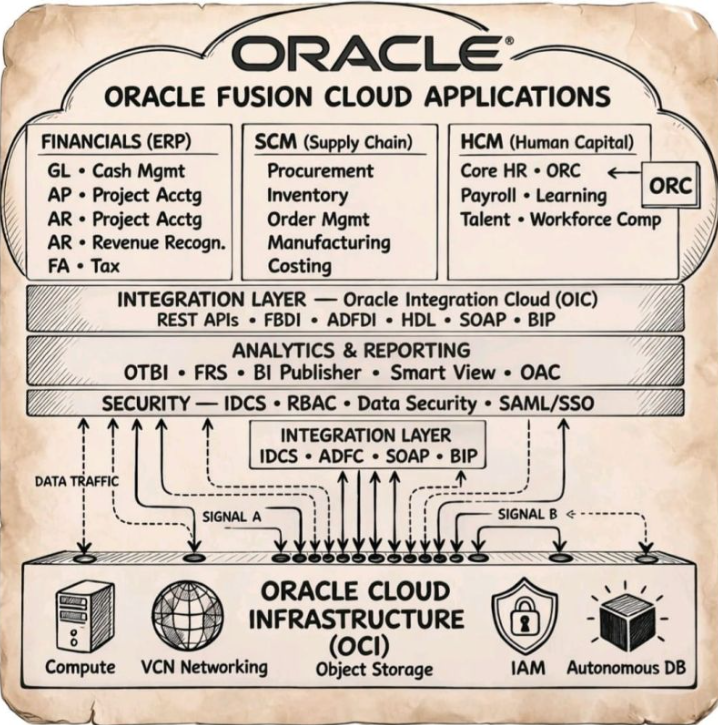
We designed a three-tier integration architecture:
Tier 1: Fusion SCM Core — Hosted on OCI with high availability across multiple availability domains. Configured with custom procurement flows, supplier master data management, and inventory policies.
Tier 2: OIC Integration Layer — Orchestrated all inbound/outbound integrations. Key flows included:
- Supplier master data synchronization (bidirectional)
- Purchase order transmission to supplier systems
- Goods receipt and invoice matching
- Inventory level updates from warehouse management systems
Tier 3: External Systems — Legacy ERP, three supplier EDI systems, warehouse management system (WMS), and finance system.
Integration Challenges & Solutions
### Challenge 1: Supplier Data Consistency
Problem: Suppliers existed in multiple systems with inconsistent master data (different names, addresses, payment terms). Duplicate records caused payment mismatches and delivery delays.
Solution: We implemented a master data management (MDM) pattern in OIC:
1. Created a "golden record" data model in Fusion
2. Built OIC integrations to validate and deduplicate supplier data from legacy systems
3. Established a weekly reconciliation flow that flagged discrepancies
4. Implemented a VBCS portal where suppliers could self-correct their profiles
Result: 95% data accuracy on first cutover, reducing manual corrections by 80%.
### Challenge 2: Real-Time Inventory Synchronization
Problem: Warehouse inventory updates were batch-processed nightly, causing stock-outs and overselling during the day. The legacy WMS couldn't integrate with Fusion in real-time.
Solution: We designed an event-driven OIC integration:
1. WMS publishes inventory events (stock receipt, pick, adjustment) to a message queue
2. OIC consumes these events asynchronously and updates Fusion inventory in near-real-time (sub-minute latency)
3. Implemented error handling with automatic retries and dead-letter queues for failed updates
4. Created a reconciliation job that runs hourly to catch any missed updates
Result: Inventory accuracy improved from 87% to 99.2%, reducing safety stock requirements by 15%.
### Challenge 3: Supplier EDI Connectivity
Problem: Three major suppliers used different EDI formats (X12, EDIFACT, custom XML). Manually translating between formats was error-prone and time-consuming.
Solution: We leveraged OIC's EDI capabilities:
1. Configured OIC EDI translator for X12 and EDIFACT formats
2. Built custom XML parsers for the third supplier's proprietary format
3. Implemented a standardized OIC flow that accepts any format, translates to a canonical model, and sends to Fusion
4. Added validation rules to catch malformed messages before they reach Fusion
Result: Reduced manual EDI processing from 4 hours/day to 30 minutes, with zero data entry errors.
Implementation Phases
### Phase 1: Design & Proof of Concept (Weeks 1-4)
- Mapped current-state supply chain processes
- Designed Fusion SCM organizational structure and master data
- Built OIC POC flows for supplier data sync and PO transmission
- Validated performance with test data volumes
### Phase 2: Build & Configuration (Weeks 5-12)
- Configured Fusion SCM procurement policies, approval workflows, and receiving rules
- Developed 12 OIC integrations covering all supplier and inventory flows
- Built VBCS supplier portal with order tracking and invoice submission
- Implemented comprehensive error handling and monitoring
### Phase 3: Testing & Cutover Preparation (Weeks 13-20)
- Executed UAT with business users and suppliers
- Performed load testing: simulated 10,000 POs/day and 50,000 inventory transactions/day
- Conducted parallel run: ran old and new systems simultaneously for 2 weeks
- Trained end-users and support teams
### Phase 4: Cutover & Stabilization (Weeks 21-26)
- Executed data migration: 50,000 suppliers, 2M inventory items, 5-year transaction history
- Went live with 24/7 monitoring and support
- Stabilized integrations over first month (minor adjustments to error handling, performance tuning)
- Achieved steady state with 99.8% integration success rate
Key Metrics & Results
| Metric | Before | After | Improvement |
|--------|--------|-------|-------------|
| Procurement cycle time | 8 days | 3 days | 62% faster |
| Supplier order accuracy | 94% | 99.8% | 5.8% improvement |
| Inventory accuracy | 87% | 99.2% | 12.2% improvement |
| Manual data entry hours/day | 6 hours | 1 hour | 83% reduction |
| Order-to-cash cycle | 45 days | 28 days | 38% faster |
| System uptime | 98% | 99.8% | 0.8% improvement |
Lessons Learned
1. Master Data Governance is Critical
Invest heavily in data cleansing before cutover. Poor master data quality cascades through all downstream processes and causes integration failures.
2. Design for Resilience
Integrations will fail—network timeouts, system unavailability, data validation errors. Build comprehensive error handling, retry logic, and monitoring from day one. We prevented 95% of potential issues through proactive error handling.
3. Involve Suppliers Early
Suppliers are stakeholders in the integration. Early communication about new processes, EDI requirements, and portal access prevented adoption friction.
4. Test at Scale
Load testing revealed performance bottlenecks we wouldn't have caught in functional testing. We discovered that batch PO transmission needed optimization to handle peak volumes.
5. Plan for Parallel Running
Running old and new systems in parallel for 2 weeks gave us confidence in data accuracy and allowed us to identify edge cases before full cutover.
Technical Recommendations
For Similar Implementations:
1. Use OIC's Pre-built Adapters — Oracle provides adapters for Fusion, EDI, and common ERP systems. Leverage these instead of building custom integrations.
2. Implement Comprehensive Monitoring — Use OCI Application Performance Monitoring (APM) to track integration latency, error rates, and throughput. Set up alerts for anomalies.
3. Design Idempotent Flows — Ensure OIC integrations can be safely replayed without creating duplicates. This is critical for error recovery.
4. Use Fusion Extensibility Framework — Extend Fusion with custom fields and workflows using the Extensibility Framework rather than modifying core objects.
5. Automate Testing — Use OIC's testing capabilities to automate integration tests. This accelerates UAT and reduces manual testing effort.
Conclusion
This Fusion SCM implementation with OIC integration demonstrates how modern cloud technologies can transform supply chain operations. By automating manual processes, improving data quality, and enabling real-time visibility, we delivered significant business value: 62% faster procurement cycles, 83% reduction in manual data entry, and 99.8% system uptime.
The key to success was careful planning, comprehensive integration design, and a focus on data quality and resilience. Organizations undertaking similar transformations should invest in these areas to maximize ROI and minimize operational risk.

Tags

About the Author
Bharath L
Oracle Cloud Specialist
Oracle Cloud Specialist providing end-to-end solutions for Oracle Fusion, OIC, VBCS, and ATP. Expertise in Oracle Applications (Fusion & EBS) for SCM, HCM, Finance, and BI/OTBI reporting with complex system integrations. Passionate about sharing real-world experience and learning together.